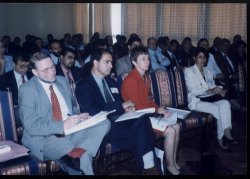


IOC Workshop on GOOS Capacity Building for the Mediterranean Region.
The GOOS Capacity Building Workshop for the Mediterranean Region (jointly supported by IOC, UNEP, the EU and the Government of Malta) was convened in Valletta, Malta, from 26 to 29 November 1997. The purpose of the Workshop was to launch MedGOOS, draft a memorandum of understanding and inform the Mediterranean countries about the Global Ocean Observing System (GOOS), and to identify and discuss capacity building needs and priorities and development of GOOS in the Mediterranean. The participants came from various Mediterranean countries and from international organisations active in the region. The needs, capability, requirements for observing systems and training, and general interest in GOOS were identified for each country.
 |
|
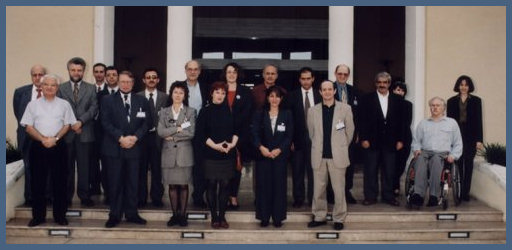
Participants to the GOOS Capacity Building Workshop, 26th-29th November 1997 - Malta |
IOC Workshop on the Benefits of the Implementation of the Global Ocean Observing System in the Mediterranean region.
The MedGOOS Workshop on the "Benefits of the Implementation of the Global Ocean Observing System in the Mediterranean Region" was held on 1-3 November 1999 in Rabat, Morocco. This was a first-time highlight of MedGOOS with a major event in a North African country. The Workshop brought together more than seventy participants, including representatives of institutions from 18 Mediterranean countries, Europe and Africa, as well as from United Nations agencies and international, governmental and non-governmental organizations.
| It provided a forum to establish the MedGOOS strategy and obtain consensus at a regional level. The Workshop also helped to broaden _ the participation in MedGOOS to all Mediterr- anean countries as well as to bring together scientists and representatives of the institu-tions involved in operational oceanography in the Mediterranean to define priorities, & plan the way forward with integration of efforts _ and appropriate measures in favour of tech-nology transfer,cooperation and capacity building elements to bring capacities in diffe-rent countries at comparable levels. The Workshop also focussed on raising the level of awareness in the region on the benefits of implementing MedGOOS, and on the linkages to the UNCLOS and the UNCED '92 follow-ups in the Mediterranean. New countries signed the MedGOOS Memorandum of Understanding and a number of others expressed the intention to do so in the near future. |
|
 |
The approval of a MedGOOS project (submitted under the EU's Fifth Framework Programme) - "The Mediterranean network to Assess and upgrade Monitoring and forecasting Activity in the region" (MAMA) - in spring 2001 was indeed a great step forward as it gave the means to start building MedGOOS concretely and to start fulfilling its objectives. |